
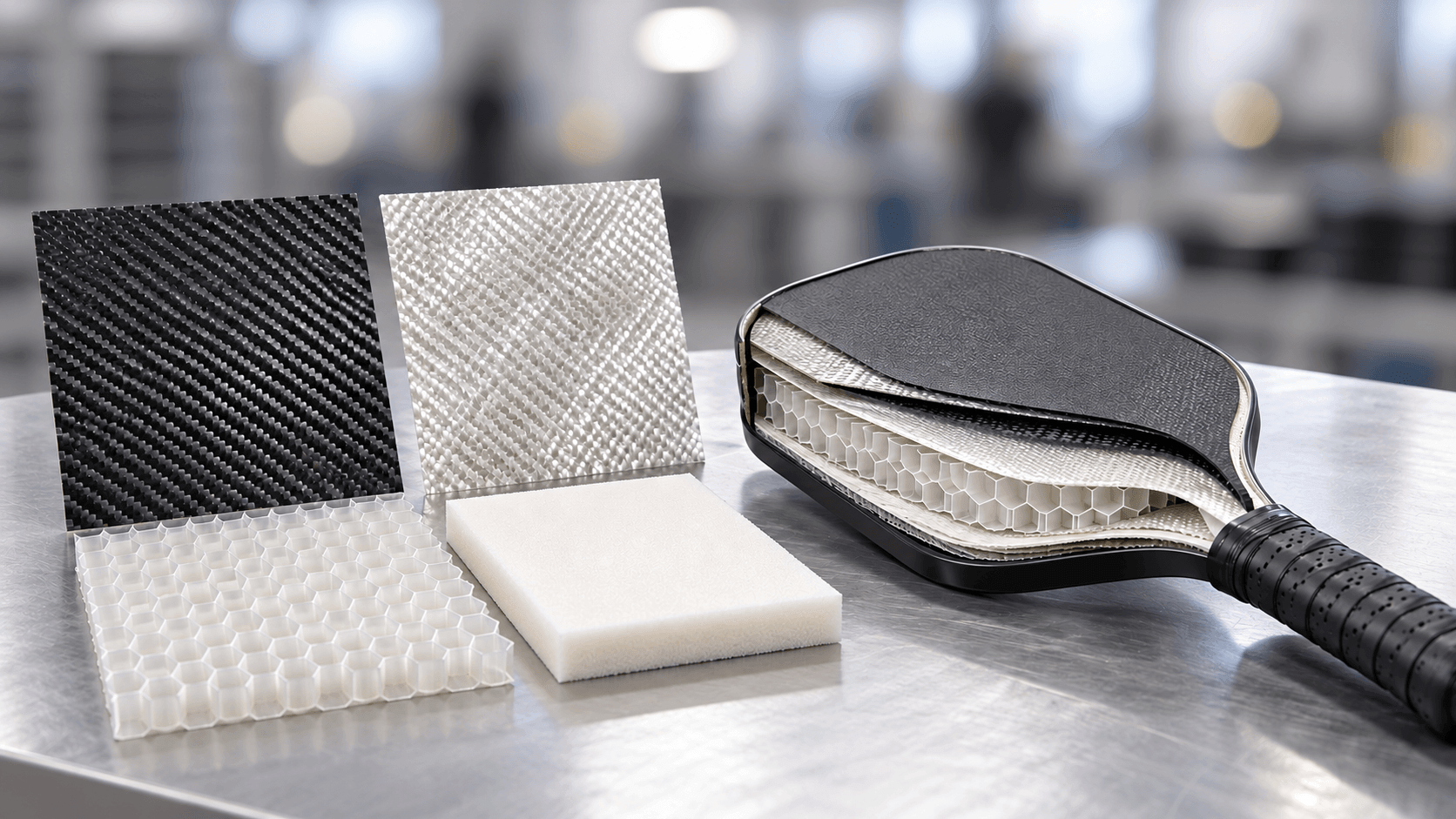
How Do Pickleball Paddle Materials Affect OEM Product Development?
Pickleball paddle materials should be selected as part of a complete construction plan. The face material, core, thickness, forming method, surface finish, shape, weight, and balance all influence the final product specification. For an OEM project, the most useful question is not which material is universally best, but which combination fits the brand’s target price, product concept, market requirements, and production plan.
The material name is only one part of the paddle specification; the complete construction must be evaluated together.
1. Carbon Fiber Face Materials
Carbon fiber is commonly considered when a brand wants a performance-focused paddle platform or a more technical product presentation. OEM projects may specify raw carbon, T700 carbon, or different visible weaves such as 3K, 12K, and 18K. These terms should be written clearly in the product brief because the visible weave, material grade, surface treatment, resin system, and manufacturing process can vary between products.
Carbon fiber selection should be confirmed with the core construction and thickness. A carbon face combined with a different core, forming method, or surface finish may produce a different product feel and appearance. For this reason, brands should review an actual sample and keep the approved material and construction details in the production specification.
2. Fiberglass Face Materials
Fiberglass is another face-material option for pickleball paddle development. It may be considered for product lines with a different target price, visual direction, or construction concept from a carbon-focused model. The selection should still be evaluated with the core, thickness, forming method, surface texture, graphics, and target weight rather than treated as an isolated material decision.
3. All-Foam Core and PP Honeycomb Core
All-Foam Core and PP honeycomb core represent different core construction directions. An all-foam structure can support a specific product concept and design approach, while PP honeycomb is widely discussed as a honeycomb core option for paddle construction. The appropriate choice depends on the intended product specification, forming method, thickness, edge construction, weight target, and manufacturing requirements.
Buyers should ask the manufacturer to identify the actual core material, core thickness, density or construction specification where relevant, edge format, and bonding or forming process. The phrase “foam core” or “honeycomb core” alone may not provide enough information to reproduce the same product in a later order.
- Core material and construction type
- Core thickness and overall paddle thickness
- Face material and surface treatment
- Edge construction and perimeter protection
- Forming or pressing method
- Target weight and balance
- Sample approval and production reference
4. Why Paddle Thickness Matters
Paddle thickness is a practical specification that should be confirmed during product development. Common project discussions may include 14 mm or 16 mm constructions, but the suitable thickness depends on the complete design and target product. Thickness can affect the relationship between the face, core, edge, weight, balance, and overall feel, so it should be reviewed together with the sample rather than selected from a number alone.
5. Cold-Pressed and Thermoformed Construction
The forming method is another important OEM decision. Cold-pressed and thermoformed constructions may require different tooling, process controls, edge formats, and development steps. A brand comparing these methods should ask the factory which construction is suitable for the proposed shape, materials, thickness, quantity, and target price. The decision should be recorded in the product specification before the sample is approved.
Thermoformed projects may involve a more integrated construction concept, while cold-pressed projects may follow a different manufacturing route. Neither method should be described as automatically superior for every product. The correct choice depends on the design brief, manufacturing feasibility, quality requirements, and the result confirmed by the approved sample.
6. A Practical Material Selection Process for Brands
- Define the product position, target market, and expected price range.
- Choose the initial face-material and core combinations to review.
- Confirm thickness, shape, handle, grip, edge, and surface requirements.
- Ask the OEM manufacturer to review feasibility and development needs.
- Compare samples using the written specification.
- Approve the final construction before production and packaging confirmation.
A clear material brief helps the factory provide a more accurate recommendation and quotation. It also gives the brand a reference for future production, quality inspection, packaging communication, and product-page content. When a material or construction changes, the brand should request a new confirmation instead of assuming that the previous sample remains equivalent.
Is carbon fiber always better than fiberglass for a pickleball paddle?
No. Carbon fiber and fiberglass serve different product-development goals. The better option depends on the complete construction, target price, product concept, surface treatment, core, thickness, and approved sample.
What is the difference between all-foam core and PP honeycomb core?
They are different core construction approaches. All-Foam Core uses a foam-based structure, while PP honeycomb uses a polypropylene honeycomb structure. The final product depends on the core specification, face materials, thickness, forming method, edge construction, and production process.
What should be included in a paddle material specification?
The specification should identify the face material, visible weave or material grade where relevant, core construction, core and paddle thickness, forming method, surface finish, shape, target weight, balance, edge format, handle, grip, and packaging requirements.
Buyer Resource Library