
What Should You Check Before Choosing a Pickleball Paddle OEM Manufacturer?
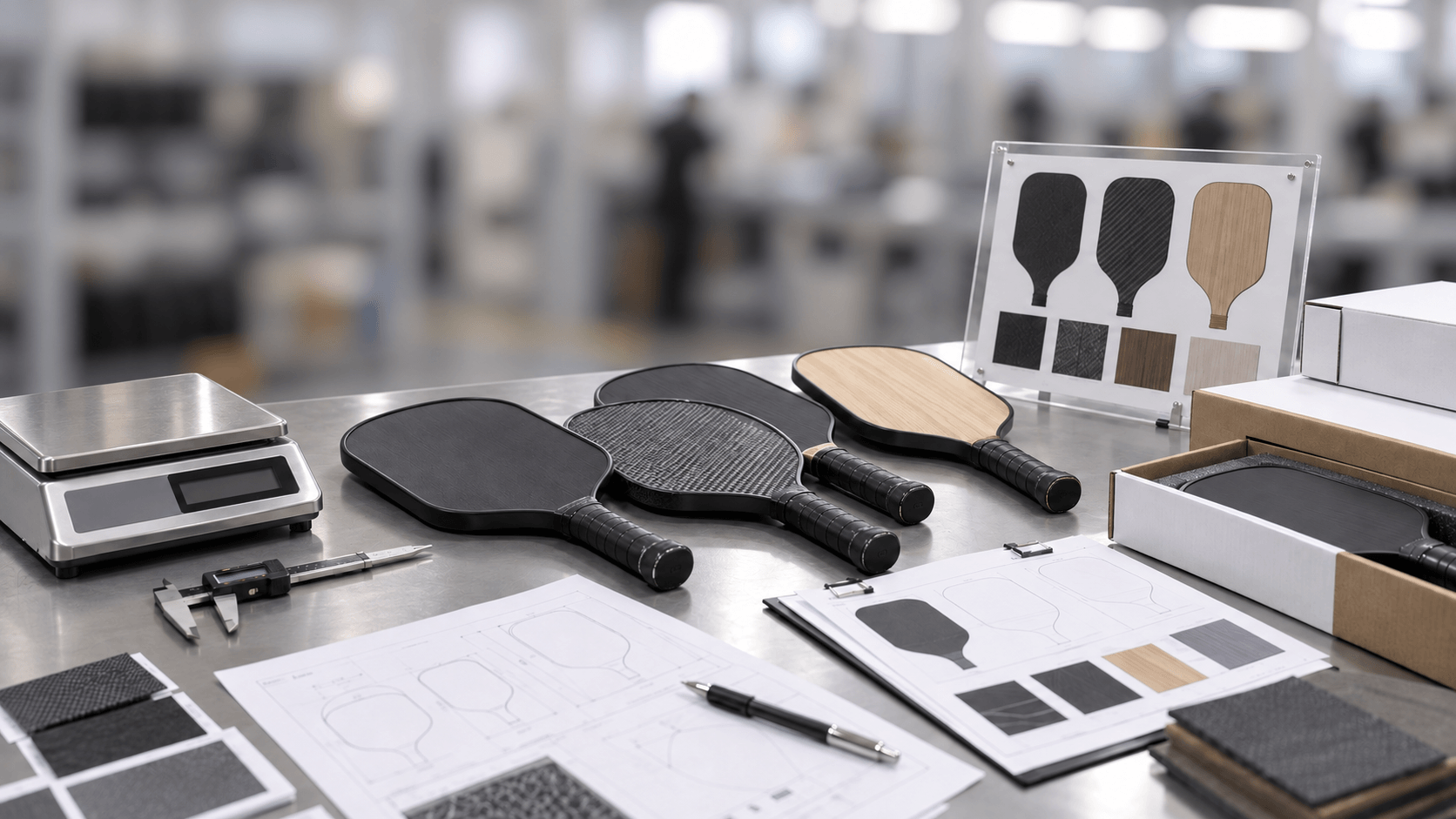
The right pickleball paddle OEM manufacturer should be able to discuss the complete product specification, not only provide a catalogue price. Buyers should review the manufacturer’s construction options, material selection, sample process, quality controls, packaging support, and communication process before confirming an order. A clear specification helps both sides reduce misunderstandings during sampling and production.
A reliable OEM project starts with a clear product brief and an approved sample.
1. Review the Manufacturer’s Product Capabilities
Start by confirming whether the factory produces the product category you need. A pickleball paddle program may require cold-pressed or thermoformed construction, different face materials, several core options, custom shapes, surface finishes, handles, grips, edge formats, and private-label packaging. A manufacturer with broader in-house experience can usually help identify specification conflicts earlier in the development process.
- Pickleball paddle construction and forming methods
- Face materials such as fiberglass and carbon fiber
- Core construction and thickness options
- Shape, handle, grip, edge, and end-cap choices
- Surface texture, graphics, and logo application
- Retail packaging, labels, and carton requirements
2. Confirm Materials and Construction Before Comparing Prices
Material names alone do not define the final paddle specification. Carbon fiber, fiberglass, core material, thickness, forming method, resin system, surface texture, weight, and balance all work together. When requesting a quotation, describe the intended construction as clearly as possible and ask the factory to confirm which parts are standard, which parts require development, and which parts depend on tooling or order requirements.
For example, a buyer may compare fiberglass, raw carbon, T700 carbon, or 3K, 12K, and 18K carbon face options. These names describe material or weave choices, but they should not be treated as automatic guarantees of a specific playing characteristic. The final result depends on the complete construction and manufacturing process. A responsible manufacturer should confirm the actual specification through samples and production documentation.
3. Use Samples to Confirm the Real Product
A sample is the practical reference for an OEM order. Before approving it, check the dimensions, thickness, target weight, balance, handle length, grip size, surface appearance, edge construction, logo placement, and packaging presentation. If the sample is intended for a regulated market or a specific approval process, the brand should also confirm the applicable requirements before mass production.
- Prepare the target product specifications and artwork.
- Ask the manufacturer to confirm the proposed construction.
- Review and test the sample against the written specification.
- Record any changes to dimensions, materials, graphics, or packaging.
- Approve the final sample before starting batch production.
4. Check Quality Control and Production Communication
Quality control should be connected to the approved sample and written specification. Useful checkpoints include dimensions, weight, surface finish, printing quality, edge alignment, handle and grip installation, packaging accuracy, and carton information. Buyers should also clarify how changes are documented, who approves them, and how production issues are communicated before shipment.
Good communication is especially important when a product contains custom materials, new graphics, special packaging, or a new mould. Ask for clear confirmation of the product version, artwork files, packaging files, quantity, destination market, and requested delivery schedule. Lead times and order quantities should be confirmed for each project rather than assumed from a general catalogue.
5. What Information Should You Send for an OEM Quote?
A more complete RFQ usually produces a more useful quotation. Include the product category or reference model, target materials, dimensions, thickness, target weight, estimated quantity, artwork status, packaging requirements, destination market, and any testing or approval requirements. If some details are not decided, state that clearly so the manufacturer can separate confirmed requirements from items that still need discussion.
- Product category or reference model
- Face material and core construction
- Dimensions, thickness, weight, and balance
- Estimated order quantity and sample quantity
- Logo, graphics, grip, and surface requirements
- Retail packaging and shipping carton requirements
- Destination market and required documentation
What does a pickleball paddle OEM manufacturer do?
A pickleball paddle OEM manufacturer develops and produces paddles according to a brand’s product specifications, materials, graphics, packaging, and order requirements. The exact services and production options should be confirmed for each project.
Should I approve a sample before placing a production order?
Yes. An approved sample gives the buyer and manufacturer a physical reference for dimensions, materials, appearance, weight, construction, graphics, and packaging before batch production begins.
Can a manufacturer help select paddle materials?
An experienced manufacturer can discuss suitable face materials, core constructions, thicknesses, forming methods, and finishing options. The final selection should be confirmed according to the product target, production requirements, and approved sample.
Buyer Resource Library